Product Description
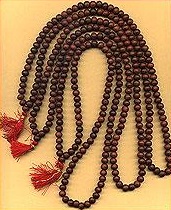
Necklaces – Mala Beads (Rosewood)
A Japa Mala or Mala is a set of beads commonly used by Hindus and Buddhists to keep count while reciting, chanting, or mentally repeating a mantra or the name or names of a deity.
Malas are typically made with 16, 27, 54 or 108 beads. In Tibetan Buddhism, traditionally malas of 108 beads are used. Some practitioners use malas of 21 or 28 beads for doing prostrations. Doing one 108 bead mala counts as 100 mantra recitations; the extra repetitions are done to amend any mistakes.
The mala string should be composed of three, five or nine threads, symbolizing the Three Jewels (Buddha, Dharma, Sangha), the five Dhyani Buddhas (Vairocana, Akshobhya, Ratnasambhava, Amitabha, Amoghasiddhi) and their wisdoms or the nine yanas or Buddha Vajradhara and eight Bodhisattvas. The large main bead, called the Guru bead, symbolizes the Guru, from whom one has received the mantra one is reciting.
Mantras are typically repeated hundreds or even thousands of times. The mala is used so that one can focus on the meaning or sound of the mantra rather than counting its repetitions. One repetition is usually said for each bead while turning the thumb clockwise around each bead, though some traditions or practices may call for counterclockwise motion or specific hand and finger usage. When arriving at the Guru bead, both Hindus and Buddhists traditionally turn the mala around and then go back in the opposing direction. Within the Buddhist tradition, this reversing of the beads serves to remind practitioners of the teaching that it is possible to break the cycle of birth and death. If more than 108 repetitions are to be done, then sometimes in Tibetan traditions grains of rice are counted out before the chanting begins and one grain is placed in a bowl for each 108 repetitions. Each time a full mala of repetitions has been completed, one grain of rice is removed from the bowl.
Many Tibetan Buddhists have bell and dorje counters (a short string of ten beads, usually silver, with a bell or dorje at the bottom), the dorje counter used to count each round of 100, and the bell counter to count 1,000 mantras per bead. These counters are placed at different points on the mala depending on tradition, sometimes at the 10th, 21st or 25th bead from the Guru bead. Traditionally, one begins the mala in the direction of the dorje (skillful means) proceeding on to the bell (wisdom) with each round. A ‘bhum’ counter, often a small brass or silver clasp in the shape of a jewel or wheel, is used to count 10,000 repetitions, and is moved forward between the main beads of the mala, starting at the Guru bead, with each accumulation of 10,000.